Physicists Observe Exotic Room-Temperature Quantum State Where Light Acts Simultaneously as Solid and Frictionless Superfluid
Breakthrough condensed matter research published in top physics journals demonstrates polariton quantum condensation without cryogenic cooling, opening revolutionary pathways for room-temperature photonic computing.

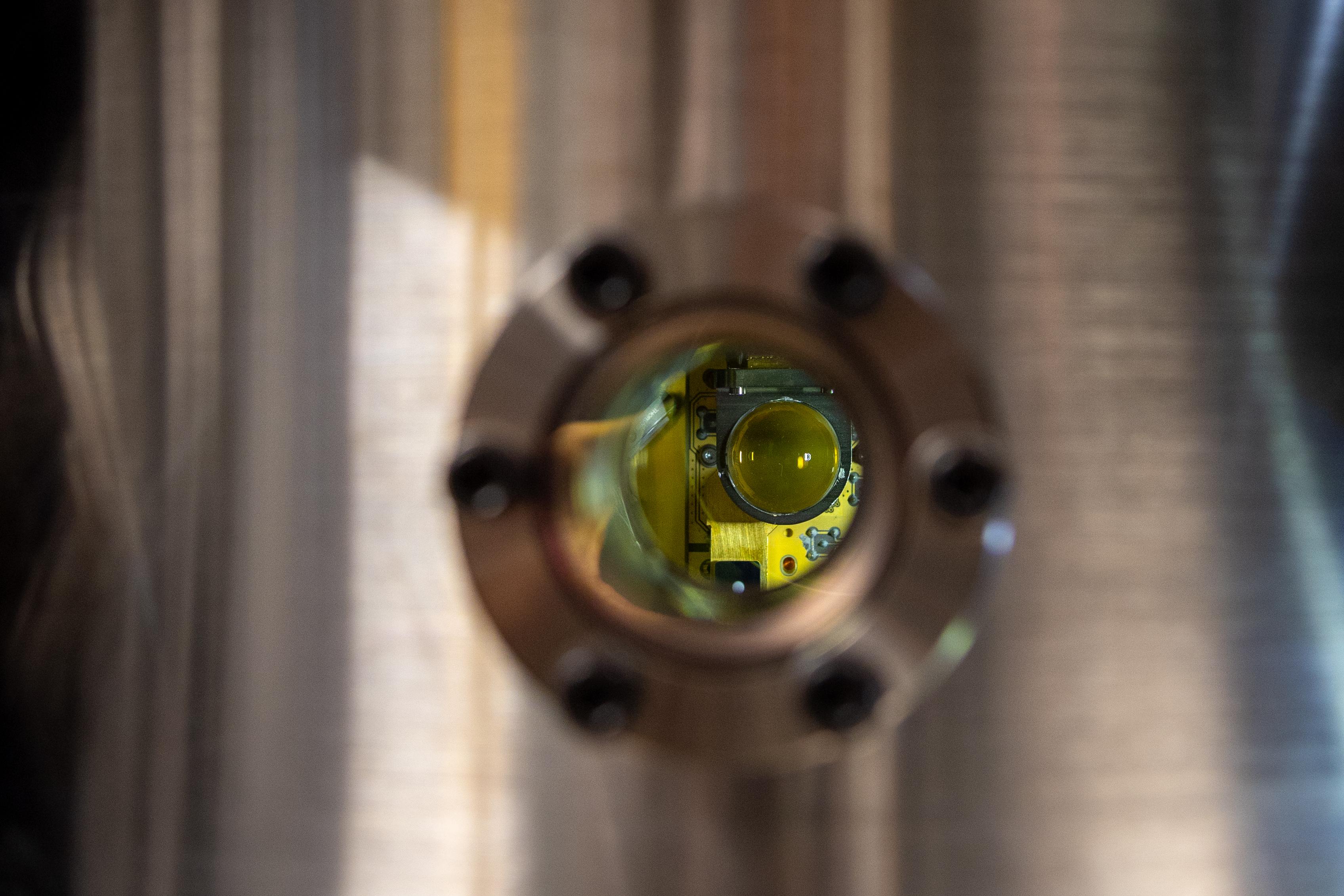
CAMBRIDGE, Mass. — In what scientific commentators are calling one of the most consequential breakthroughs in modern condensed matter physics, a collaborative research team from premier American and international quantum institutions announced Tuesday the successful observation of a room-temperature quantum state where light behaves simultaneously as an ordered crystal and a frictionless superfluid.
Published in peer-reviewed scientific journals, the experiment trapped photons within atomically thin semiconductor microcavities synthesized from advanced metal-organic frameworks. By strongly coupling incoming laser light with localized electron-hole pairs (excitons), researchers created hybrid quasi-particles known as polaritons.
Under ordinary physical conditions, generating quantum condensation—such as Bose-Einstein condensates—demands massive, energy-intensive cryogenic dilution refrigerators operating at fractions of a degree above absolute zero (-273.15°C). In this landmark trial, however, the specialized crystalline architecture forced polaritons to spontaneously synchronize their quantum wavefunctions at standard ambient room temperature (22°C).
The resulting physical state demonstrated extraordinary dual characteristics: the polaritons locked into rigid spatial lattice patterns characteristic of solid crystals, yet simultaneously flowed around physical impurities and nano-scale obstacles with zero viscosity, mimicking frictionless liquid superfluids.
Technology executives and quantum computer architects hailed the demonstration as a monumental stride toward practical, energy-efficient photonic computing. Eliminating the necessity for massive cryogenic cooling could enable optical transistors, ultra-secure quantum communications, and neuromorphic optical processors to operate within standard data center racks and consumer hardware footprints.
Research institutions are currently partnering with major domestic semiconductor fabrication consortiums to scale the microcavity synthesis techniques, setting up commercial prototyping programs aimed at developing room-temperature optical quantum processors within the next three to five years.
Related Coverage

Nvidia Board Initiates Independent Investigation Following CEO Jensen Huang's Disclosures Amid Silicon Valley Scrutiny
The semiconductor giant’s board has retained outside legal counsel to conduct an independent review after chief executive Jensen Huang disclosed past personal relationships subject to national security scrutiny.

Marvell and Lumentum Announce Milestone $115 Billion Merger to Accelerate Optical AI Infrastructure
In one of the largest semiconductor transactions in history, the combined entity aims to eliminate critical optical and electrical networking bottlenecks inside next-generation artificial intelligence data centers.

Qualcomm and UC San Diego Unveil Major AI-Driven Chip Design Initiative to Reinvent Energy-Efficient Silicon
The new academic-industry alliance leverages advanced generative models to automate circuit placement and thermal dissipation, reducing semiconductor development cycles from years to months.